Skip to content
Flex Warehouse Park Small-Bay Industrial

Why Small-Bay Industrial

A large, essential segment of the industrial market that institutional capital has largely passed over.

Not because it lacks demand — but because it is harder to operate. We think that difficulty is precisely what makes it interesting.

01 — Definition

What is small-bay industrial?

Industrial buildings divided into smaller units — typically 1,000 to 5,000 square feet — designed for local operating businesses rather than regional distribution.

Research publishers use building-level definitions. CBRE defines shallow-bay industrial as buildings under 50,000 square feet with clear heights between 14 and 28 feet. Others use light industrial for buildings under 150,000 square feet. The unit sizes inside those buildings are what determine who can actually occupy them.

The functional specification matters more than the label: grade-level roll-up door access, adequate power, usable clear height, a small office component, parking for vehicles and crew, and a legitimate business address.

Source: CBRE, “Shallow-Bay Industrial Availability Remains Tight Amid Strong Demand” , March 24, 2026.
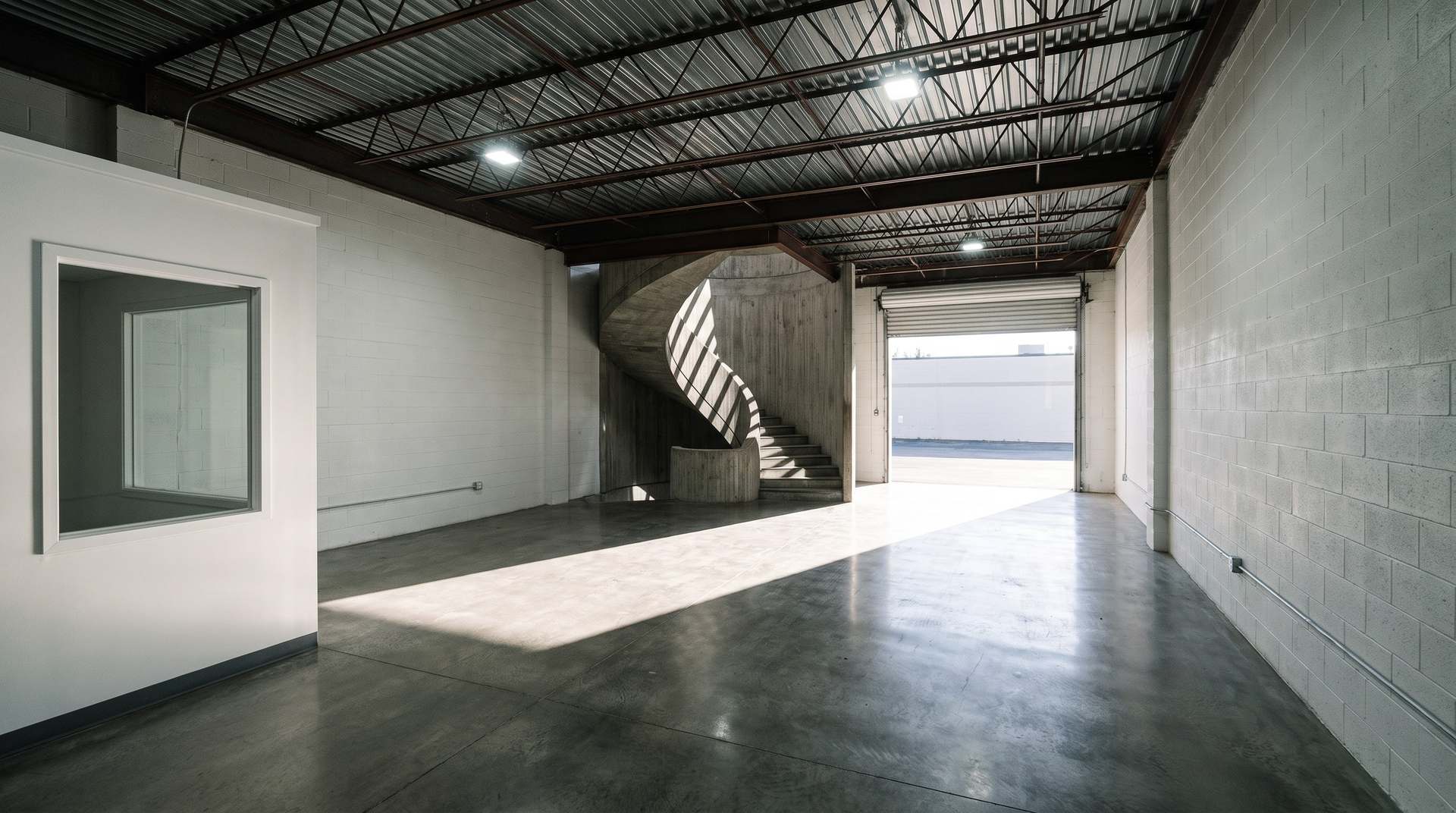
Interior of a clean, empty small-bay industrial unit with sealed concrete floor, exposed steel roof structure and an open roll-up door

The Unit

Sealed floor, clear height, grade-level roll-up access and a small office — the functional specification that matters more than the label.

02 — Occupiers

Who occupies it?

A cross-section of the local economy rather than a single industry or supply chain.

ContractorsHVACPlumbingElectricalRoofingLandscapingE-commerceSmall distributorsSpecialty tradesService companiesLight manufacturingMakers & fabricatorsAuto & fleet servicesBuilding supply

61%

Of net new US job creation since 1995 came from small businesses

Small businesses represent 99% of all firms and 46% of private sector employees.

99%

Of all US firms are small businesses

They account for 46% of private sector employees.

Source: Corebridge Financial, “Light Industrial Outlook: Small Bay, Big Play” , June 2025.

03 — The Gap

Why smaller businesses need this space.

A business does not step from a garage into a distribution centre. It moves through a progression — and one rung is structurally under-supplied.

  1. Under 500 SF

    Garage / Home

    The business starts where the owner lives. Inventory in the garage, vehicles on the driveway, no separation between household and operation.

  2. 100 – 500 SF

    Self Storage

    Storage solves square footage but not operations. No power for tools, no drive-in access for a loaded vehicle, no address a business can actually run from.

  3. 1,000 – 5,000 SF

    Flex Warehouse Park

    Small-Bay Industrial

    A right-sized unit with a roll-up door, power, clear height and a real business address. Room for vehicles, crew, inventory and a small office — at a rent a growing local business can carry.

  4. 10,000 SF +

    Traditional Industrial

    Conventional warehouse and distribution product, generally underwritten by institutional capital for larger and better-capitalised occupiers.

The gap we focus on. A business that has outgrown a garage or a storage unit, but cannot justify — or find — a conventional industrial building, has limited options. That constraint is the tenant's problem. It is also, in our view, the investor's opportunity.

04 — Supply

Why supply can be constrained.

Small-format industrial is expensive to build relative to the rent it can command.

Subdividing a building multiplies the cost of demising walls, roll-up doors, electrical service, plumbing and life-safety systems. Fixed development costs spread across less leasable area. Land basis in the infill locations these tenants need is high. Faced with a choice between one large tenant and fifteen small ones, a developer generally has an easier route to a financeable project with the former.

The consequence is an inventory that is largely inherited rather than built. CBRE reports that new development over the past cycle has been overwhelmingly big-box, with relatively little construction of facilities under 50,000 square feet.

80%

Of shallow-bay inventory built before 2000

Nearly half was built prior to 1980. Properties built since 2010 account for only 5% of total inventory.

0.5%

Small-bay under construction as a share of existing stock

Roughly 90 million SF of small-bay industrial under construction nationwide.

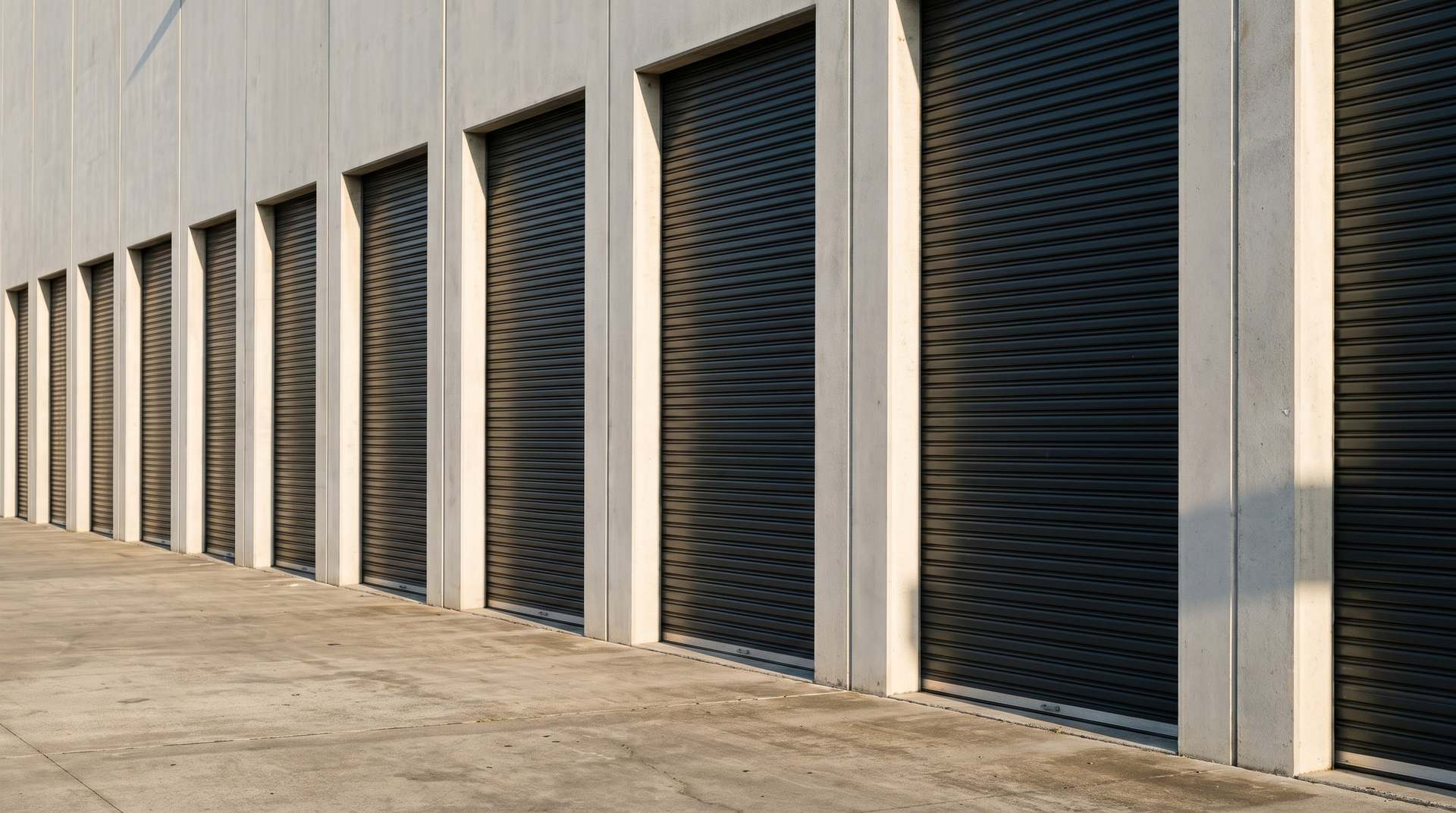
A repeating rhythm of charcoal roll-up doors on a concrete industrial facade in raking afternoon light

Supply

Most of this stock was inherited, not built. Construction economics do not favour replacing it.

05 — Ownership

Why ownership remains fragmented.

Much of the small-bay stock is held by local operators, founding families, retiring owner-occupiers and individual investors — frequently a single building held for decades.

That pattern tends to produce below-market rents, deferred capital, informal leasing and no consistent standard of presentation. This is not poor stewardship; it is the natural limit of owning one building. It is also what leaves room for an operator to add value through work rather than through market movement.

06 — Institutional Focus

Why larger owners looked elsewhere.

Deploying institutional capital efficiently favours large cheques into large assets with few tenants. A single 500,000 square foot lease is administratively simpler than two hundred leases of 2,500 square feet, even where the latter produce comparable income.

Corebridge reports that light industrial under 150,000 square feet made up 62% of 2024 industrial transaction volume, while institutional buyers accounted for 20% of that volume — up from 16% in 2023. The segment carries the majority of transactions and a minority of institutional participation.

Source: Corebridge Financial, “Light Industrial Outlook: Small Bay, Big Play” , June 2025.

07 & 08 — The Opportunity

Why professionalisation and clustering may create operating leverage.

An operator with several assets in a market can do things a single-asset owner structurally cannot.

01

Broad Tenant Demand

A diversified base of contractors, trades, distributors and service businesses requires functional industrial space near the customers they serve. This demand is generated by local economic activity rather than by any single national tenant or supply chain.

02

Fragmented Ownership

Much of the small-bay stock remains held by local operators, founding families and individual investors. Fragmentation is what creates the opportunity to aggregate, professionalise and operate at a scale the individual owner cannot.

03

Constrained Supply

Small-bay inventory is difficult to replicate economically in desirable infill locations. Construction pricing, land basis and the fixed costs of subdividing space all work against new small-format supply.

04

Granular Rent Roll

A building leased to many small tenants behaves differently from one leased to a single occupier. No single expiry defines the asset, and income is spread across a wider set of businesses and industries.

05

Operational Value Creation

Leasing, property management, capital improvements, unit reconfiguration, brand standards and tenant experience are levers an operator controls directly. We believe returns in this segment are earned through operations, not assumed through cap rate compression.

06

Scalability

A repeatable property-level model — consistent unit sizes, specifications, systems and standards — can be extended across assets and markets, building density where operating leverage is strongest.

The honest caveat

Aggregation is not automatic value creation. Buying fragmented assets at full price and managing them exactly as the previous owner did simply produces a larger version of the same result. Everything above depends on acquiring at a sensible basis and then doing the operational work. We would rather state that plainly than imply the segment does the work for us.

Common Questions

Frequently asked.

What is small-bay industrial?

Industrial buildings divided into smaller units — typically around 1,000 to 5,000 square feet — serving local and regional businesses. Industry research often refers to the broader category as shallow-bay or light industrial, generally describing buildings under 50,000 square feet.

How is this different from self storage?

Self storage holds goods. Small-bay industrial houses operating businesses. The distinction matters: tenants need power, drive-in access, clear height, a business address and the ability to run a crew and vehicles from the premises.

Who are the tenants?

Predominantly local operating businesses — contractors and trades, service companies, small distributors, e-commerce operators, light manufacturers and makers. Demand is generated by local economic activity rather than a single national supply chain.

What is Flex Warehouse Park’s relationship with Northwind?

Flex Warehouse Park is the dedicated small-bay industrial platform of Northwind Investment Group. Northwind provides platform context, underwriting discipline and capital relationships.

Are you raising capital through this website?

No. This website is informational. It does not constitute an offer to sell or a solicitation of an offer to buy any security, and it does not describe the terms of any offering. Enquiries lead to a conversation, not a transaction.

What kind of opportunities do you review?

Existing small-bay and flex industrial assets, portfolios, repositioning and lease-up situations, development sites, sale-leasebacks and joint ventures. Our property profile page sets out the general criteria.

Relationships

Understand the segment. Then evaluate the platform.

If this thesis resonates, we would welcome a conversation about how we are approaching it.